E-BOOK
编译原理 英文版 第2版
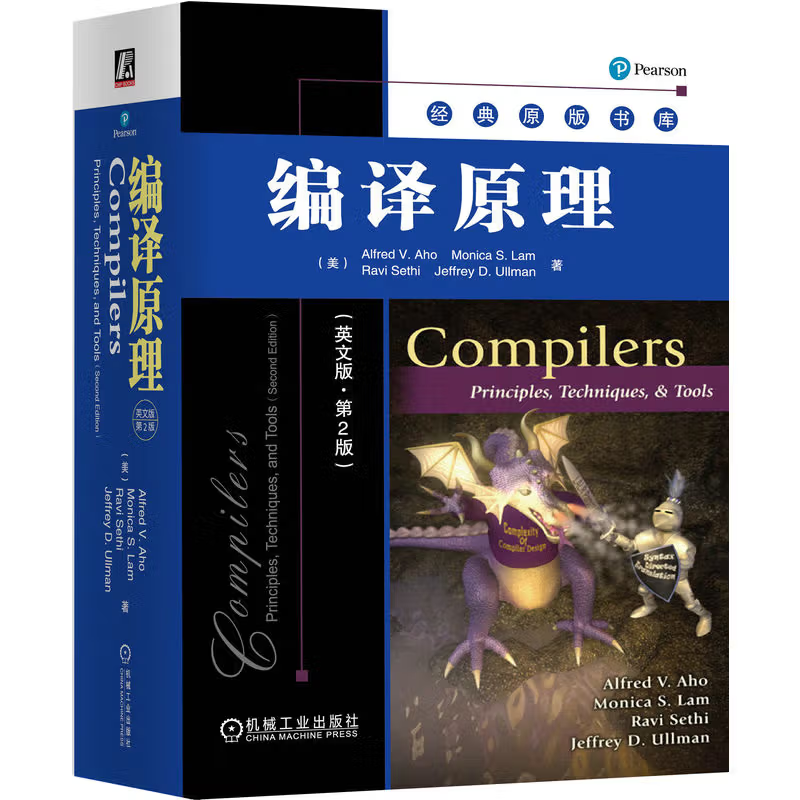
编译原理 英文版 第2版
📥 PDF 电子书 · 百度网盘 · 约 90M
👤 Alfred V.Aho
📖 机械工业出版社
📋 9787111326748
🌐 zh-CN
343
下载次数
4.8
用户评分
📦 下载本书
- 理解编译器结构:全面掌握编译器的各个阶段,从词法分析到代码生成,建立完整的编译过程知识体系。
- 掌握语法分析技术:深入学习自顶向下和自底向上的语法分析方法,能够设计并实现高效的语法分析器。
- 学会语法制导翻译:理解语法制导定义和翻译方案,能够将源语言转换为中间代码或目标代码。
- 掌握代码优化方法:学习各种代码优化技术,如常量传播、死代码消除等,提升生成代码的执行效率。
- 理解运行时环境:了解存储组织、作用域和参数传递机制,掌握运行时环境的构建与管理。
★★★
中级
入门初级中级进阶高级
- 计算机专业研究生:本书是编译原理课程的经典教材,适合研究生深入研读,掌握编译器设计的核心理论。
- 编译器开发者:从事编译器或相关工具开发的工程师,可通过本书系统提升编译器设计与实现能力。
- 系统软件工程师:对编程语言实现、虚拟机或运行时环境感兴趣的开发者,能从中获得底层实现的深刻理解。
- 计算机科学研究者:研究编程语言、程序分析或优化技术的学者,可将本书作为权威参考。
- 循序渐进:建议按章节顺序阅读,先掌握词法分析和语法分析,再深入中间代码生成和优化,避免跳跃。
- 重视练习:每章后的习题是巩固知识的关键,建议动手实现小型编译器项目,将理论付诸实践。
- 结合工具:使用Lex和Yacc等工具辅助实验,加深对词法和语法分析器的理解。
- 重点突破:第4章语法分析和第9章代码优化是难点,可反复阅读并结合实例分析。
- 参考阅读:遇到疑难时,可参考《现代编译原理》或相关论文,补充背景知识。
- 系统知识:全面掌握编译器设计的各个阶段,从词法分析到代码优化,构建完整的知识框架。
- 分析能力:学会使用形式化方法描述语言和文法,提升问题建模与算法设计能力。
- 实践技能:通过实现编译器组件,具备设计和开发实际编译器的工程能力。
- 优化思维:理解代码优化的原理与实现,能够编写更高效的代码并优化现有程序。
- 学术视野:了解编译技术的前沿研究,为后续学术研究或高级系统开发打下坚实基础。
📖 书籍简介
产品特色
编辑推荐
本书是编译领域无可替代的经典著作,被广大计算机专业人士誉为“龙书”。自本书上一版于1986年出版以来,被世界各地的著名高等院校和研究机构(包括美国哥伦比亚大学、斯坦福大学、哈佛大学、普林斯顿大学、贝尔实验室)作为本科生和研究生的编译原理课程的教材。该书对我国计算机教育领域也具有重大影响。
内容简介
本书全面、深入地探讨了编译器设计方面的重要主题,包括词法分析、语法分析、语法制导定义和语法制导翻译、运行时刻环境、目标代码生成、代码优化技术、并行性检测以及过程间分析技术,并在相关章节中给出大量实例。
作者简介
Alfred V.Aho,美国歌伦比亚大学教授,美国国家工程院院士,ACM和IEEE会士,曾获得IEEE的冯·诺伊曼奖。著有多部算法、数据结构、编译器、数据库系统及计算机科学基础方面的著作。 Monica S.Lam,斯坦福大学计算机科学系教授,曾任Tensilica的首席科学家,也是Moka5的首任CEO。曾经主持SUIF项目,该项目产生了研究用编译器之一。 Ravi Sethi,Avaya实验室总裁,曾任贝尔实验室高级副总裁和Lucent Technologies通信软件的CTO。他曾在宾夕法尼亚州立大学,亚利桑那州立大学和普林斯顿大学任教,是ACM会士。 Jefirey D.Ullman斯坦福大学计算机科学系教授和Gradiance CEO。他的研究兴趣包括数据库理论、数据库集成、数据挖掘和利用信息基础设施教学等。他是美国国家工程学院院士、IEEE会士,获得过ACM的Karlstrom杰出教育奖和Knuth奖。
目录
TableofContents
1Introduction1
1.1 Language Pro cessors 1
1.1.1 Exercises for Section 1.1 3
1.2 The Structure of a Compiler 4
1.2.1 Lexical Analysis 5
1.2.2 Syntax Analysis 8
1.2.3 Semantic Analysis 8
1.2.4 Intermediate Co de Generation 9
1.2.5 Co de Optimization 10
1.2.6 Co de Generation 10
1.2.7 Symb ol-Table Management 11
1.2.8 The Grouping of Phases into Passes 11
1.2.9 Compiler-Construction To ols 12
1.3 The Evolution of Programming Languages 12
1.3.1 The Move to Higher-level Languages 13
1.3.2 Impacts on Compilers 14
1.3.3 Exercises for Section 1.3 14
1.4 The Science of Building a Compiler 15
1.4.1 Mo deling in Compiler Design and Implementation 15
1.4.2 The Science of Co de Optimization 15
1.5 Applications of Compiler Technology 17
1.5.1 Implementation of High-Level Programming Languages 17
1.5.2 Optimizations for Computer Architectures 19
1.5.3 Design of New Computer Architectures 21
1.5.4 Program Translations 22
1.5.5 Software Pro ductivity To ols 23
1.6 Programming Language Basics 25
1.6.1 The Static/Dynamic Distinction 25
1.6.2 Environments and States 26
1.6.3 Static Scop e and Blo ck Structure 28
1.6.4 Explicit Access Control 31
1.6.5 Dynamic Scop e 31
1.6.6 Parameter Passing Mechanisms 33
1.6.7 Aliasing 35
1.6.8 Exercises for Section 1.6 35
1.7 Summary of Chapter 1 36
1.8 References for Chapter 1 .38
2ASimpleSyntax-DirectedTranslator39
2.1 Intro duction 40
2.2 Syntax De nition 42
2.2.1 De nition of Grammars 42
2.2.2 Derivations 44
2.2.3 Parse Trees 45
2.2.4 Ambiguity. 47
2.2.5 Asso ciativity of Op erators 48
2.2.6 Precedence of Op erators 48
2.2.7 Exercises for Section 2.2 51
2.3 Syntax-Directed Translation 52
2.3.1 Post x Notation 53
2.3.2 Synthesized Attributes 54
2.3.3 Simple Syntax-Directed De nitions 56
2.3.4 Tree Traversals 56
2.3.5 Translation Schemes 57
2.3.6 Exercises for Section 2.3 60
2.4 Parsing .60
2.4.1 Top-Down Parsing 61
2.4.2 Predictive Parsing 64
2.4.3 When to Use -Pro ductions 65
2.4.4 Designing a Predictive Parser 66
2.4.5 Left Recursion 67
2.4.6 Exercises for Section 2.4 68
2.5 A Translator for Simple Expressions 68
2.5.1 Abstract and Concrete Syntax 69
2.5.2 Adapting the Translation Scheme 70
2.5.3 Pro cedures for the Nonterminals 72
2.5.4 Simplifying the Translator 73
2.5.5 The Complete Program 74
2.6 Lexical Analysis .76
2.6.1 Removal of White Space and Comments 77
2.6.2 Reading Ahead 78
2.6.3 Constants 78
2.6.4 Recognizing Keywords and Identi ers 79
2.6.5 A Lexical Analyzer 81
2.6.6 Exercises for Section 2.6 84
2.7 Symbol Tables .85
2.7.1 Symbol Table Per Scop e 86
2.7.2 The Use of Symbol Tables 89
2.8 Intermediate Co de Generation 91
2.8.1 Two Kinds of Intermediate Representations 91
2.8.2 Construction of Syntax Trees 92
2.8.3 Static Checking 97
2.8.4 Three-Address Co de 99
2.8.5 Exercises for Section 2.8 105
2.9 Summary of Chapter 2 .105
3LexicalAnalysis109
3.1 The Role of the Lexical Analyzer .109
3.1.1 Lexical Analysis Versus Parsing 110
3.1.2 Tokens, Patterns, and Lexemes 111
3.1.3 Attributes for Tokens 112
3.1.4 Lexical Errors 113
3.1.5 Exercises for Section 3.1 114
3.2 Input Bu ering .115
3.2.1 Bu er Pairs 115
3.2.2 Sentinels 116
3.3 Sp eci cation of Tokens 116
3.3.1 Strings and Languages 117
3.3.2 Op erations on Languages 119
3.3.3 Regular Expressions 120
3.3.4 Regular De nitions 123
3.3.5 Extensions of Regular Expressions 124
3.3.6 Exercises for Section 3.3 125
3.4 Recognition of Tokens 128
3.4.1 Transition Diagrams 130
3.4.2 Recognition of Reserved Words and Identi ers 132
3.4.3 Completion of the Running Example 133
3.4.4 Architecture of a Transition-Diagram-Based Lexical An-alyzer .. 134
3.4.5 Exercises for Section 3.4 136
3.5 The Lexical-Analyzer Generator Lex. 140
3.5.1 Use of Lex. 140
3.5.2 Structure of LexPrograms 1
📑 章节目录
- 引言:语言处理器与编译器结构
- 词法分析:正则表达式与有限自动机
- 语法分析:上下文无关文法与自顶向下分析
- 语法分析:自底向上分析与LR文法
- 语法制导定义与语法制导翻译
- 中间代码生成:三地址码与类型检查
- 运行时刻环境:存储组织与访问控制
- 目标代码生成:指令选择与寄存器分配
- 代码优化:基本块与数据流分析
- 代码优化:循环优化与全局优化
- 并行性检测与过程间分析
- 高级主题:编译器构造工具与未来趋势